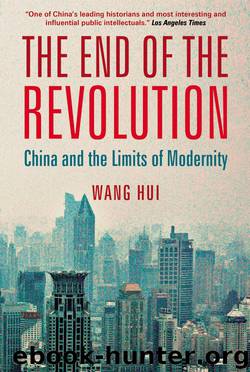
The End of the Revolution by Wang Hui
Author:Wang Hui
Language: eng
Format: epub
Publisher: Verso
Published: 2011-03-14T16:00:00+00:00
I was personally most influenced by the second of these traditions: social history. If in our inquiries we ignore the social, political, ethical, or moral practices connected to any body of thought, including Neo-Confucianism in China, that tradition will be very difficult to understand. What this means is that in our intellectual histories we cannot neglect the fundamental social conditions that are produced by intellectual activities, the relationship between social movements and these bodies of thought. Thus, my explanatory perspective and methodology came to involve gradually more of the methodology of social history. However, that methodology also brings with it various problems. The fundamental background to this method of social history is the development of modern social science in the West, which is something we can never shed. The theory of social science grew in its entirety from the development of European and Western societies from the nineteenth to the twentieth century. In other words, in the tradition of intellectual history, if we view social sciences as a product of specific historical conditions (despite its reliance on building models, structure, and theories), then we must ask what relation is constituted between such historically specific knowledge and the theories that we are now trying to examine. This has also become an important question.
I cite a simple example: the writing of social history always places a high value on economic history. Whether within the Marxist school of intellectual history or other schools, none can stray far in their explanations from the economic sphere, and only once economics has been discussed can the spheres of politics and society be tackled. Certainly, the concept of “economy” was already present in ancient China—its equivalent was shengji (“livelihood”), which developed gradually and was very comprehensive. Until modern times—the late nineteenth to early twentieth century—Liang Qichao and others used the term shengjixue (“study of livelihoods,” sometimes translated as “political economy”) and referenced guojixue (“national economies”) in their early translations of and introductions to Adam Smith’s works, which was only later translated into jingjixue (“economics”). This is also to say that categories like “economy,” produced by European capitalism in the nineteenth century, only then came to predominate over all the particular categories in the other domains of life. But economy-based studies of social phenomena are also produced under unique historical conditions. Modern social science is established on the basis of a particular social taxonomy and social morphology, including such classifications as economy, politics, society, and culture. Our scholarly research corresponds to this, being divided into the fields of political science, sociology, economics, and cultural anthropology, among others. We can clearly see the connection between modern social science classifications and the modern social division of labor. We study economics, political science, sociology, and cultural studies, and we transform our knowledge from these sciences into universally applicable methods to understand our own times, as well as our ancient history. When we do this, it is in a sense to restructure our past traditions and history, as well as to reconstruct history based upon a particular, modern classification of knowledge.
Download
This site does not store any files on its server. We only index and link to content provided by other sites. Please contact the content providers to delete copyright contents if any and email us, we'll remove relevant links or contents immediately.
| Arms Control | Diplomacy |
| Security | Trades & Tariffs |
| Treaties | African |
| Asian | Australian & Oceanian |
| Canadian | Caribbean & Latin American |
| European | Middle Eastern |
| Russian & Former Soviet Union |
The Secret History by Donna Tartt(18974)
The Social Justice Warrior Handbook by Lisa De Pasquale(12172)
Thirteen Reasons Why by Jay Asher(8858)
This Is How You Lose Her by Junot Diaz(6846)
Weapons of Math Destruction by Cathy O'Neil(6231)
Zero to One by Peter Thiel(5743)
Beartown by Fredrik Backman(5691)
The Myth of the Strong Leader by Archie Brown(5475)
The Fire Next Time by James Baldwin(5398)
How Democracies Die by Steven Levitsky & Daniel Ziblatt(5185)
Promise Me, Dad by Joe Biden(5120)
Stone's Rules by Roger Stone(5060)
A Higher Loyalty: Truth, Lies, and Leadership by James Comey(4925)
100 Deadly Skills by Clint Emerson(4888)
Rise and Kill First by Ronen Bergman(4747)
Secrecy World by Jake Bernstein(4713)
The David Icke Guide to the Global Conspiracy (and how to end it) by David Icke(4664)
The Farm by Tom Rob Smith(4475)
The Doomsday Machine by Daniel Ellsberg(4463)
